
Revenue Infrastructure Consulting
Sustainable Revenue Performance Requires Structural Integrity
Krzyz Systems Consulting audits, restructures, and validates revenue systems for established businesses experiencing inefficiency, leakage, or structural misalignment.

our process
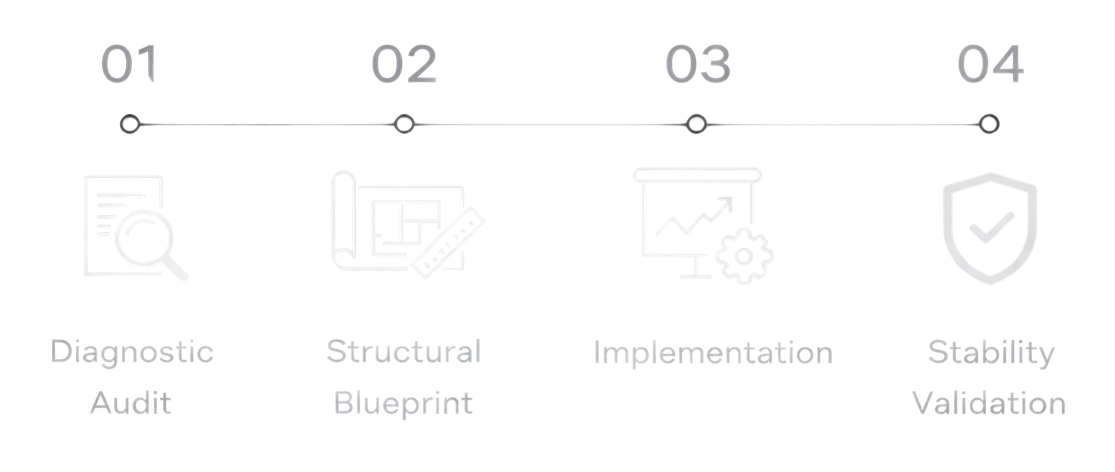
Who We Are
Krzyz Systems Consulting, Founded by David Krzyz, was established to diagnose and correct structural inefficiencies within established revenue systems. We operate at the intersection of strategy, architecture, and execution — auditing existing infrastructure, identifying leakage and misalignment, and rebuilding systems for long-term stability.
Our work focuses on structural correction. We align revenue infrastructure, automation, messaging, and operational flow into disciplined, measurable systems designed for sustained performance.
We partner with established businesses committed to long-term performance and system integrity.
Revenue Infrastructure Consulting
Sustainable Revenue Performance Requires Structural Integrity
Krzyz Systems Consulting audits, restructures, and validates revenue systems for established businesses experiencing inefficiency, leakage, or structural misalignment.
our process
Who We Are
Krzyz Systems Consulting, Founded by David Krzyz, was established to diagnose and correct structural inefficiencies within established revenue systems. We operate at the intersection of strategy, architecture, and execution — auditing existing infrastructure, identifying leakage and misalignment, and rebuilding systems for long-term stability.
Our work focuses on structural correction. We align revenue infrastructure, automation, messaging, and operational flow into disciplined, measurable systems designed for sustained performance.
We partner with established businesses committed to long-term performance and system integrity.
The Systems Infrastructure Framework
Identifying Inefficiencies at A System Level
Phase 01 — Diagnostic Audit
Structural correction begins with clarity. We begin with a comprehensive audit of your existing backend infrastructure — including funnel architecture, CRM configuration, automation logic, messaging flow, and lifecycle sequencing.
Our objective is not surface-level optimization. We assess structural alignment, identify leakage points, eliminate systemic redundancies, and evaluate how each component interacts across the broader system.
This phase produces a clear structural diagnosis — defining bottlenecks, what is functioning and what must be rebuilt to support long-term stability.


Mapping the structural foundation
Phase 02 — Structural Blueprint
In Phase 02, we translate the audit into a precise structural blueprint — mapping corrected funnel architecture, CRM structure, automation logic, messaging flow, and lifecycle sequencing so every component has a defined role and connection point.
This is where the build plan is defined — what stays, what gets removed, what gets rebuilt, and how the entire infrastructure functions as one coherent system.
The output is an implementation-grade structural blueprint — disciplined, measurable, and engineered to eliminate misalignment while establishing the foundation for long-term stability.
The Systems Infrastructure Framework
Identifying Inefficiencies at A System Level
Phase 01 — Diagnostic Audit
Structural correction begins with clarity. We begin with a comprehensive audit of your existing backend infrastructure — including funnel architecture, CRM configuration, automation logic, messaging flow, and lifecycle sequencing.
Our objective is not surface-level optimization. We assess structural alignment, identify leakage points, eliminate systemic redundancies, and evaluate how each component interacts across the broader system.
This phase produces a clear structural diagnosis — defining bottlenecks, what is functioning and what must be rebuilt to support long-term stability.
Mapping the structural foundation
Phase 02 — Structural Blueprint
In Phase 02, we translate the audit into a precise structural blueprint — mapping corrected funnel architecture, CRM structure, automation logic, messaging flow, and lifecycle sequencing so every component has a defined role and connection point.
This is where the build plan is defined — what stays, what gets removed, what gets rebuilt, and how the entire infrastructure functions as one coherent system.
The output is an implementation-grade structural blueprint — disciplined, measurable, and engineered to eliminate misalignment while establishing the foundation for long-term stability.
ENGINEERING THE SYSTEM FOR EXECUTION
Phase 03 — Implementation & Integration
In Phase 03, the approved structural blueprint is executed at a systems level. Each defined specification is translated into a controlled configuration across funnel architecture, CRM structure, automation logic, messaging flow, and lifecycle sequencing.
This is disciplined deployment — rebuilding and standardizing infrastructure to eliminate misalignment, remove systemic redundancy, and ensure every component operates within a cohesive framework.
All integrations, dependencies, and connection points are validated to confirm operational cohesion and long-term integrity. The result is a fully engineered backend environment — aligned, controlled, and built for sustained performance.

VALIDATING LONG-TERM STRUCTURAL STABILITY
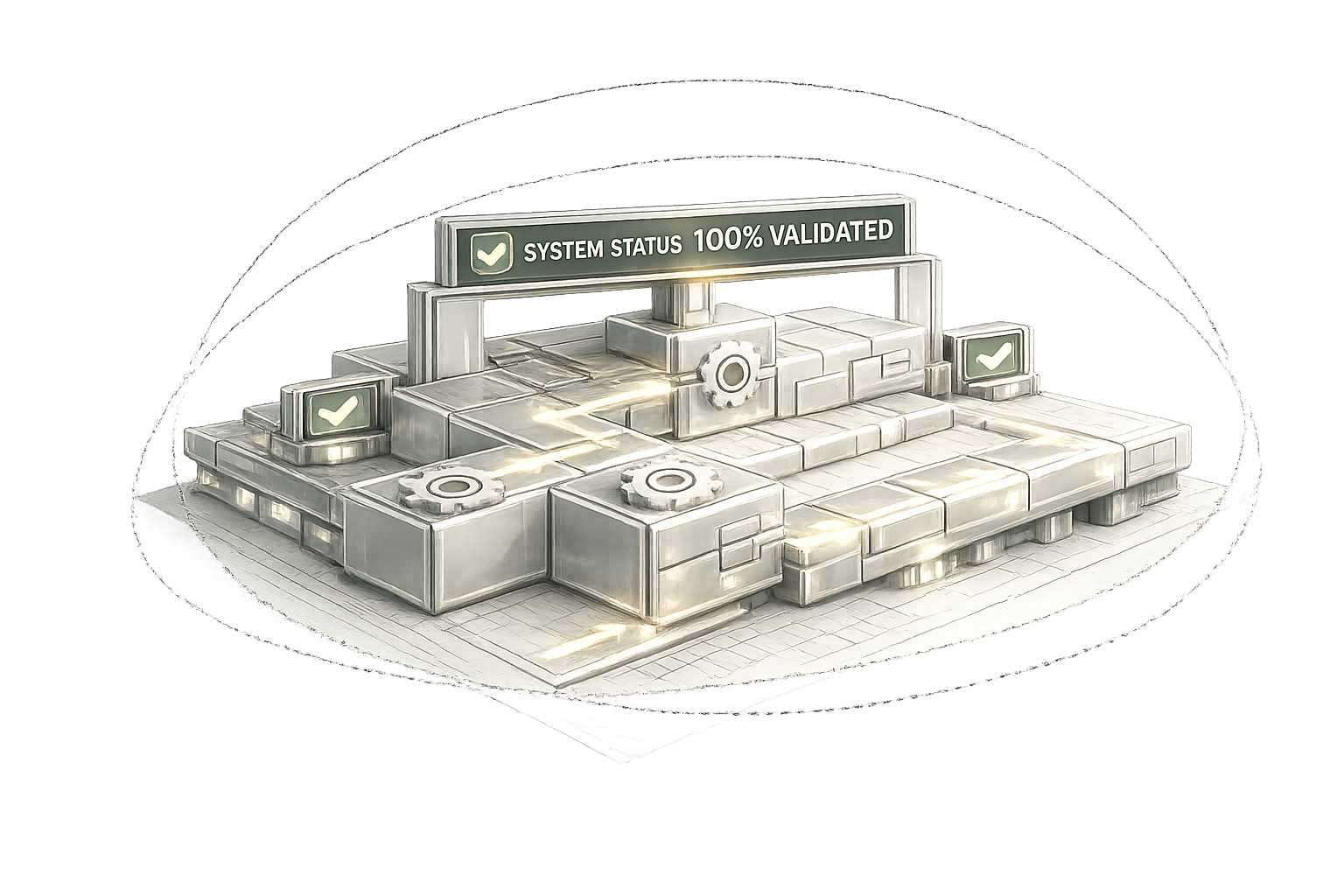
Phase 04 — Stability Validation & Performance Monitoring
Following implementation, the system enters a defined 60-day validation window. During this period, the infrastructure operates under live conditions while performance, data integrity, and automation reliability are continuously monitored at a systems level.
We evaluate real-world execution across funnel architecture, CRM structure, automation logic, messaging flow, and lifecycle sequencing to confirm that each component performs exactly as engineered. Conversion pathways, handoff points, and reporting accuracy are reviewed to ensure operational cohesion.
This phase is not redesign. It is structured validation — identifying minor calibration needs, reinforcing alignment, and confirming that the system sustains measurable performance without structural drift. The result is a stabilized, performance-verified infrastructure that operates as a unified revenue-generating system engineered for long-term durability.
ENGINEERING THE SYSTEM FOR EXECUTION
Phase 03 — Implementation & Integration
In Phase 03, the approved structural blueprint is executed at a systems level. Each defined specification is translated into a controlled configuration across funnel architecture, CRM structure, automation logic, messaging flow, and lifecycle sequencing.
This is disciplined deployment — rebuilding and standardizing infrastructure to eliminate misalignment, remove systemic redundancy, and ensure every component operates within a cohesive framework.
All integrations, dependencies, and connection points are validated to confirm operational cohesion and long-term integrity. The result is a fully engineered backend environment — aligned, controlled, and built for sustained performance.
VALIDATING LONG-TERM STRUCTURAL STABILITY
Phase 04 — Stability Validation & Performance Monitoring
Following implementation, the system enters a defined 60-day validation window. During this period, the infrastructure operates under live conditions while performance, data integrity, and automation reliability are continuously monitored at a systems level.
We evaluate real-world execution across funnel architecture, CRM structure, automation logic, messaging flow, and lifecycle sequencing to confirm that each component performs exactly as engineered. Conversion pathways, handoff points, and reporting accuracy are reviewed to ensure operational cohesion.
This phase is not redesign. It is structured validation — identifying minor calibration needs, reinforcing alignment, and confirming that the system sustains measurable performance without structural drift. The result is a stabilized, performance-verified infrastructure that operates as a unified revenue-generating system engineered for long-term durability.
Where Foundational Revenue Systems Break Down
The recurring structural failures we most commonly diagnose during systems-level audits.

01 — Fragmented Funnel Architecture
Conversion pathways are frequently constructed in isolation, without unified routing logic or lifecycle sequencing. When landing pages, capture points, follow-up flows, and CRM integration are misaligned, performance degrades long before it becomes visible in revenue metrics.

02 — Unstructured CRM Environments
Improper pipeline configuration, inconsistent tagging logic, and undefined lifecycle states distort visibility across the system. Without disciplined structure, reporting becomes unreliable and operational decision-making deteriorates.

03 — Automation Redundancy & Conflict
Layered workflows, overlapping triggers, and conflicting conditional logic introduce instability into otherwise functional systems. Over time, this redundancy creates friction, errors, and unpredictable behavior across the infrastructure.

04 — Lifecycle Sequencing Gaps
Many systems fail to account for structured progression between acquisition, nurture, conversion, and retention. When sequencing logic is incomplete or misconfigured, engagement weakens and conversion pathways break down.

05 — Data & Attribution Distortion
Inaccurate event tracking, improper source attribution, and inconsistent reporting architecture lead to false performance signals. Decisions are then made on misrepresented data, compounding structural inefficiencies.

06 — Infrastructure Fragility at Scale
Systems that function under limited volume frequently deteriorate under increased demand. Without engineered scalability, automation timing, routing logic, and workflow dependencies begin to fail as throughput increases.
Begin The Systems Assessment Process
A structured consultation designed to evaluate operational cohesion, architectural integrity, and scalability readiness across your revenue infrastructure.
Copyrights by Krzyz Systems Consulting ™ 2026| Terms & Conditions